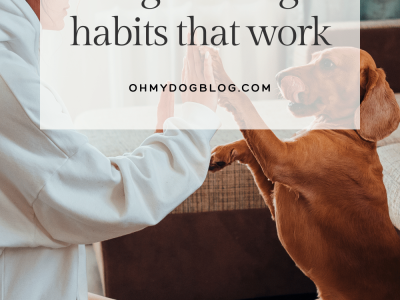
When it comes to dog training, it’s easy to over-complicate things.
You might feel like you need big chunks of time, all the tools, and a prepared training plan just to get started–but the truth is, real progress usually comes from small, steady habits.
Today, I’m sharing a few simple dog training habits that have made a real difference for us. My life is already so super chaotic, so these strategies won’t overwhelm you or burn you out (or your dog, for that matter). It’s just sustainable momentum you can actually stick with.
BTW: If you are ready to dig deeper into positive reinforcement training without guessing your way through, you’ll love my free book, POSITIVE REINFORCEMENT TRAINING FOR DOGS OF ALL ABILITIES. It’s packed with simple steps to help you build steady progress without the overwhelm, no matter your or your dog’s abilities.
But you don’t need it to get started with this. Less over-complicating, right? (;
Let’s dig in, shall we?
Why We Over-Complicate Dog Training
Dog training can feel harder than it needs to. Why?
Well, for one thing, the vast majority of us are not Dog Trainers, as in professionally trained trainers. We’re people with dogs who want to work with our own pets. There can be some insecurity there or even self-doubt.
For another thing, so many of us don’t have any time. I understand this isn’t the case for everyone, but for lots of folks, finding time to do anything beyond the daily requirements can feel impossible.
But I have some good news for you!
Both of those common assumptions–that you need expertise and that you need loads of time–are both myths.
It’s a mistake to assume you need to be a pro to train your own dog, and it’s a mistake to assume you need a large chunk of time to make real progress.
Here is the quick reframe we all (myself included) need:
Progress = small moves, done consistently.
Simple Dog Training Habits That Actually Work
So, let’s talk about those small moves and how to do them consistently. I don’t know about you, but I need to break everything down into the smallest possible components in order to avoid overwhelm. That goes for work, house projects, learning something new, and training my dogs. Again: progress happens through small moves done consistently.
Here are 3 ways (plus an optional extra) to make those dog training habits simple:
Turn your daily routine into training opportunities
Did you know that almost half of our day is done without much thought? Research suggests that a significant portion of our daily actions, around 40-43 percent, are driven by our habits and routines. That means you have a ton of time each day where you can integrate short bursts of training.
For example:
When you feed your dog, ask him to sit before you set down the bowl.
Before you let your pup outside, ask for a hand touch.
As you leash up for your walk, practice a stand cue or something over-the-top like turn off the lights before you leave.
You certainly don’t want to ask your dog to do something before every single step in your daily routine. You’ll both burn out from that. But toss in a cue here and there to reinforce nice manners or new behaviors. This habit works because you’ll make a lot of progress without dedicated blocks of training time. It makes dog training easier because it’s already using parts of your day.
Aim for several short sessions, not one long one
This is probably the most practical tip for me. If you’re like me, you probably don’t have an hour to squeeze in a training session. Any spare hour I have gets filled up immediately. Instead, what I strive for is to utilize little pockets of transition time.
Here’s an actual example from my day: John leaves to drive Astrid to school, and Stola and I walk Violet to the bus stop. When we get back from the bus, I take off her harness, and Stola follows me into the kitchen where I cook my breakfast and tidy the kitchen. As I’m cooking, I work on our current focus–either ignoring the cats if they happen to show up at the same time or a longer duration for her sit. As I unload and reload the dishwasher, we continue the same behavior. This gives us five to 15 minutes every weekday to practice while I’m moving the rest of my day forward.
We also practice cues like “on your bed” and longer sits when Violet does her homework at the kitchen table. It’s a natural point in the day when I have a few minutes to focus on Stola while I’m also monitoring Violet’s homework.
Even if there’s not another chance to work with her during the day, those two pockets give me a solid 15-20 minutes almost every day. That really adds up!
Watch for reinforcement opportunities
Keep your pockets full!
I keep my pockets stuffed full of treats all day every day. I work from home, and I strive to find reinforcement opportunities outside of prescriptive training.
Stola spots Newt and doesn’t chase? Thumbs up and a cookie!
Penny sits nicely to greet the kids at the afternoon bus stop? Thumbs up and a cookie!
While we aren’t Dog Training, we are training in those moments, and they really add up. Plus, it’s more practical for them to learn how to navigate the human world when it’s in the moment rather than in a training ring.
Plus, this strategy helps avoid that concern about not being a professional or not having enough training experience. It’s your life, and you’re reinforcing your dog for how best to navigate what that’s like!
Take the show on the road(optional)
I encourage you to take your dog out and about with you when it’s possible and appropriate. I say this from a place of deep understanding. For years, we couldn’t go anywhere with dear Cooper because he simply couldn’t handle public spaces. With Lucas, we couldn’t take him anywhere there might be dogs, which is basically everywhere that’s dog friendly sooooooo… between him and Coop, we went nowhere for more than a decade.
That’s not the case for Penny and Stola. They both love people and dogs and being out. So, when we can take them with us intentionally and be focused on their behavior, we do. We get tons of training opportunities to practice polite greetings at Lowe’s and a million chances to practice not smashing into every small child out of extreme enthusiasm (STOLA) when I can work with her at the edge of a playground while the girls swing.
If this is a possibility, I encourage you to do it. If it’s not a possibility, I’m with you in solidarity.
How to Start Small (Without Burning Out)
- Pick one habit to focus on this week. One. Don’t try it all. Maybe stuff your pockets full of cookies in the morning, and watch for reinforcement opportunities throughout the day. That’s a great place to start.
- Set a tiny first step (Example: “Instead of I’ll teach my dog three new behaviors this week,” brainstorm one itty-bitty place to start, like “I’ll reinforce a sit cue every time my dog wanders over to my desk to say hi.”)
- Celebrate consistency, not perfection!
Conclusion
Building a dog training practice through small, consistent daily actions doesn’t have to feel heavy.
With a few simple habits and steady effort, you can make real progress–without the stress, overthinking, or burnout.
Which dog training habits are you excited to try first? Let me know in the comments–or save this post to come back to anytime you need a fresh start.
P.S. If you’re ready to make your positive reinforcement training journey even easier, don’t forget to grab your free copy of POSITIVE REINFORCEMENT TRAINING FOR DOGS OF ALL ABILITIES!
It’s designed to help you simplify positive reinforcement training step-by-step–and build real momentum without burning yourself (or your dog) out.


This is such a great reminder! I have the problem that my dog is so enthusiastic when i have a treat that she’ll run through sit-highfive-laydown-rollover in a 3 second span without recognizing what I’ve asked. Here are all my tricks, mom! Lol. I think I need to me more aware of her energy state when we train.
That is so cute and funny! Although I also understand it’s not super helpful when trying to get some focus. (:
Recently, I’ve started trying to train with Stola right after her walk or after we do some play with the flirt pole or her jolly ball for the same reason you mentioned–the energy state makes a big different in learning. Let me know how your progress is coming along!!
I love this post, and it came at a perfect time for us. Your advice is so practical. 9 year old Birdie arrived three weeks ago, and all of her meals are training opportunities (as in, “here’s the routine in this household” – we’re starting small, as you advise). We’re doing a lot of “This one for Rowan, this one for Birdie”, as well as “being on a mat makes treats happen; lying in the middle of the kitchen doesn’t”. We have no formal training sessions, just little bits of catching good behavior all day.
Scritches to Penny and Stola!
One more thing. Birdie’s nails were very overgrown upon arrival. They were clipped as short as possible at her first vet visit, but still needed work. We use a Dremel, so I needed to get her comfortable with the tool ASAP. We’ve been playing Nail Dremel every evening. Rowan loves having her nails done (lots of treats happen), so she eagerly hops up on the couch. I grind off a millimeter of nail. At the end of each paw, she gets treats, I turn to Birdie, tap the Dremel on one of her nails, and jackpot with treats. Rowan is used to one day a week pedicures, but seems to enjoy our daily 2-minute spa treatment, and Birdie is getting used to the ‘daily grind’.
Welcome, Birdie!! What a lucky pup to land in your home! (Also, I adore that name… so, so precious!)
It sounds like you have such a great handle on your routine and integrating small training opportunities into your everyday.
Your Dremel training sounds fantastic. I’m thinking we need to switch to something like that because the clippers send Stola into a bit of a fit. I also saw the idea of a scratch board, so I’m weighing those options. I really appreciate you sharing how you approach things. You’ve inspired some new ideas for me!!
Scritches for your crew, too!